
Using Executive Function Skills to Study Smarter, Not Harder: 10 Tips to Prepare for Exams
- Dec 9, 2025
- 6 min read
Studying isn’t just about effort- it’s about the brain skills that make studying possible: executive function. Executive function is how students plan, prioritize, start tasks, manage time, sustain attention, regulate emotions, and follow through. TGlearn focuses on strengthening these skills so students can be responsible, efficient, and productive in school and life.
Below are 10 executive-function-friendly exam tips for high school and college students, plus TGlearn tools and strategies—Learn the Term®, Recall Pattern, and multisensory supports—to help students build lasting study skills
1) Make a Study Map (so your brain isn’t carrying everything)
When a test feels like “everything,” it’s hard to start—and easy to procrastinate. A Study Map gets the plan out of your head and onto paper so you can see exactly what to do and when to do it.
Try this (10 minutes):
List what will be tested: units, chapters, question types, essay themes, vocab sets
Highlight the “high value” topics: biggest points, most confusing, most likely to appear
Chunk it down: break topics into 20–40 minute study tasks (small enough to start)
Calendar it: assign chunks to specific days (and add a cushion day if you can)
Gather your materials: old tests/quizzes, study guides, notes, textbooks, rubrics, Learn the Term® Cards/flashcards, formula sheets
Executive Function Call-Out: Planning, prioritizing, organization, time management
2) Turn “To-Do” into “Do/Done” (specific tasks = easier follow-through)
Vague tasks (“study biology”) don’t trigger action. Specific tasks do.
Instead of: Study Chapter 7 Write:
Make 5 Learn the Term® Cards from section 7.1
Do 10 practice questions
Review mistakes and write 2 takeaways
Executive Function Call-Out: Task breakdown, goal setting, follow-through
3) Use the “Minimum Start” to Beat Procrastination
For many students, starting is the hardest part. Make the first step tiny so your brain says “yes.”
Minimum Start options:
“Open and set up” (notes out, timer on, target written)
Do one problem / write two sentences
Work for 2 minutes, then decide whether to continue
Executive Function Call-Out: Task initiation, emotional regulation, persistence
4) Use Focus Cycles (Pomodoro) so attention has a finish line
Studying for hours without breaks drains executive function. Focus cycles protect attention and prevent burnout.
Try Pomodoro Technique (Focus Cycles):
Set a timer for 25 minutes
Work on one specific task with minimal distractions
When the timer goes off, take a 5-minute break (stand up, hydrate, stretch)
After 4 Pomodoros, take a longer break (15–30 minutes) to fully reset
If 25 minutes feels too long, start with 15/5 and build up
This structure boosts focus, reduces procrastination, and helps prevent burnout

Important: Don’t study 4 hours straight without a real break—your brain needs recovery time to stay sharp.
Executive Function Call-Out: Sustained attention, time management, self-monitoring (TGlearn also highlights structured routines, schedules, and tools like timers as practical executive function supports.) TGlearn Blog
5) Build a Reward System (motivation is easier when it’s built in)
Willpower runs out. Rewards help your brain associate studying with progress.
Use “small breaks + big breaks”:
Small break after each focus cycle: water, stretch, quick reset
Big break after 3–4 cycles: snack, walk, fresh air, movement
Add simple “study treats” (non-distracting cues):
Mint gum or mints (study-only cue)
A new water bottle or fun cup
New pens/highlighters or fresh notebook paper
Executive Function Call-Out: Motivation, persistence, emotional regulation, habit-building (TGlearn also emphasizes positive reinforcement and persistence as supports for executive function growth.) TGlearn Blog
6) Use Multisensory Learning (don’t try to learn everything from a screen)
Many students spend hours staring at digital notes or flashcards and wonder why it doesn’t stick. Screens can help—but strong learning is usually multisensory: seeing, writing, speaking, organizing, and doing.
Quick reality check: Quizlet-style tools can be great for review, but often aren’t enough for learning brand-new material. If you only recognize an answer on-screen, you may not be able to retrieve it on a test.
Use the “Read it, Write it, Say it, Teach it” process
Read it: Identify key ideas
Write it: Handwrite steps, summaries, or an outline (writing strengthens memory)
Say it: Explain it out loud in your own words
Teach it: Teach it to someone else—even an imaginary student or your dog
If you can teach it, you’re demonstrating mastery, not just familiarity.
Executive Function Call-Out: Working memory, metacognition, sustained attention, comprehension (TGlearn’s tools also emphasize multisensory strategies to support comprehension and recall.) TGlearn Recall Strategies
7) Use TGlearn’s Recall Pattern (active recall + smarter planning)
TGlearn’s Recall Pattern helps students remember information by practicing retrieval in a predictable routine instead of rereading. It’s visual and organized: students work on a diagonal line across the page with the main topic written in the middle, so every detail they add connects back to that anchor idea. (Listed as “Recall Pattern – Writing & Study Strategy” under Educational Resources.) TGlearn Recall Strategy
How to do it (Diagonal Recall Pattern)
Draw a diagonal line from corner to corner on your paper.
Write the main topic in the middle of the diagonal (your anchor).
Recall: With notes closed, write everything you remember, branching details back to the main topic.
Check: Open notes and add corrections/missing info (use a different color if helpful).
Re-Recall: Close notes and recall again—cleaner and faster.
Repeat later: Revisit in a later session to strengthen long-term memory.
Why it works
It doesn’t just build memory—it shows students:
What they know well
What they kind of know
What they don’t know yet (and need to review)
That insight drives efficient, intentional studying instead of spending equal time on everything.
Best times to use Recall Pattern
Before studying a unit/chapter: gauge what you know and make a smarter plan of attack
After finishing a unit/chapter: end-of-unit review to see what stuck
Right before an exam: target final review on the gaps that matter most
Executive Function Call-Out: Self-monitoring, planning, organization, metacognition
8) Use TGlearn’s Learn the Term® Cards (not “just flashcards”)
Traditional flashcards often become definition-copying. TGlearn’s Learn the Term® is a notecard system developed by TGlearn Coaches to help students associate, categorize, and organize information on one card, supporting study skills, comprehension, and recall. TGlearn Learn the Term Cards

The key difference: visual + personal meaning triggers recall
Students:
Draw a picture representing the term
Write the term on the back
Use the term in a sentence that connects back to the picture
That picture + sentence creates a visual cue and personal context—so recall is
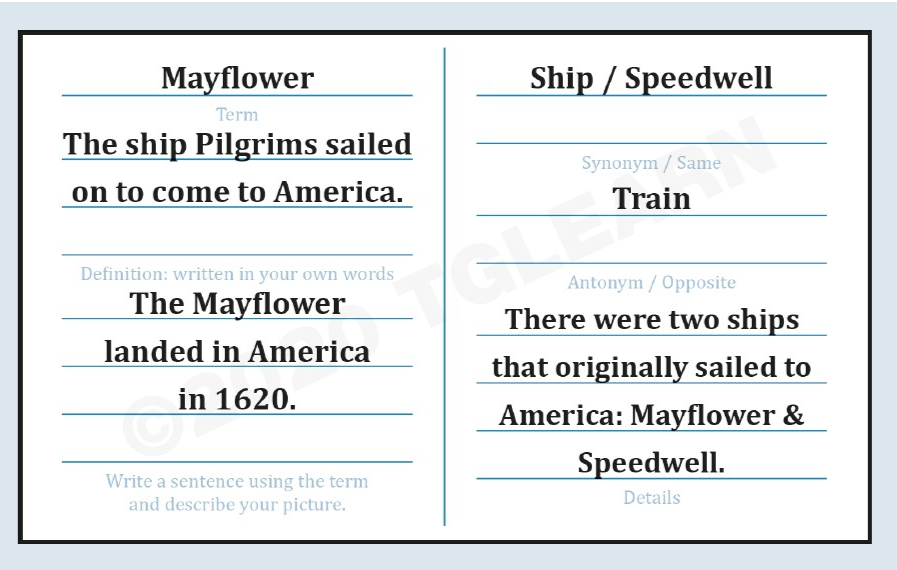
stronger under pressure.
Executive Function Call-Out: Organization, working memory support, comprehension, retrieval practice TGlearn Consultants
9) Space it, Mix it, Track Mistakes (study smarter with feedback)
Two upgrades that build long-term learning:
Spaced practice: revisit across multiple days (short sessions)
Interleaving: mix topics/problem types so you practice switching like a real test
Add a 1-minute Error Log:
What I missed
Why I missed it (content gap, rushed, misread, forgot a step)
My fix (redo, make a Learn the Term® Card, practice 5 more)
Executive Function Call-Out: Cognitive flexibility, self-monitoring, adaptive strategy use
10) Fuel Your Brain: meals, hydration, movement, and sleep (no all-nighters)
Your brain is part of your body. Exam prep works best when you support attention, stamina, and memory.
What to prioritize:
Balanced meals + hydration: steady energy supports focus and working memory
Movement + fresh air: even a short walk helps reset attention
Sleep: your brain needs sleep to rest and “soak up” information
All-nighters don’t work. Pulling an all-nighter is like running a practice marathon right before the real marathon—your brain walks into the exam worn out and tired.
Executive Function Call-Out: Emotional regulation, attention, working memory, performance readiness
Quick 7-day Exam Plan Example:
Day 1: Create study map + gather materials (study guides, notes, old tests/quizzes, rubrics) + make Learn the Term® Cards for key vocab/concepts
Day 2: Use your study guide to drive Read/Write/Say/Teach + active recall (quiz yourself with Learn the Term® Cards)
Day 3: Recall Pattern (pre-check) on a unit/chapter + mixed practice + start an error log (use study guide to fill gaps)
Day 4: Group study session: teach each other key concepts (use Read/Write/Say/Teach), quiz each other with Learn the Term® Cards, and compare what’s showing up in study guides
Day 5: Re-take an old test/quiz (timed if possible) + correct it + update error log + add/adjust Learn the Term® Cards based on misses
Day 6: Full or mini practice test (or another re-take of an old test) + big reward break + review patterns (error log + missed cards)
Day 7: Light review (study guide summary, missed cards, key formulas) + pack materials + sleep plan + meal plan before exam
Final takeaway
Studying smarter means using strategies that support executive function: planning, task initiation, focus, organization, self-monitoring, and follow-through. When students combine structured study cycles, multisensory learning, intentional rewards, and TGlearn tools like Recall Pattern and Learn the Term®, exam prep becomes more efficient—and confidence rises.
Want support building these skills? Explore executive function coaching, study strategies, and learning tools at TGlearn.com—and more resources in TGlearn’s Educational Resources and Blog. TGlearn Tools


Comments